
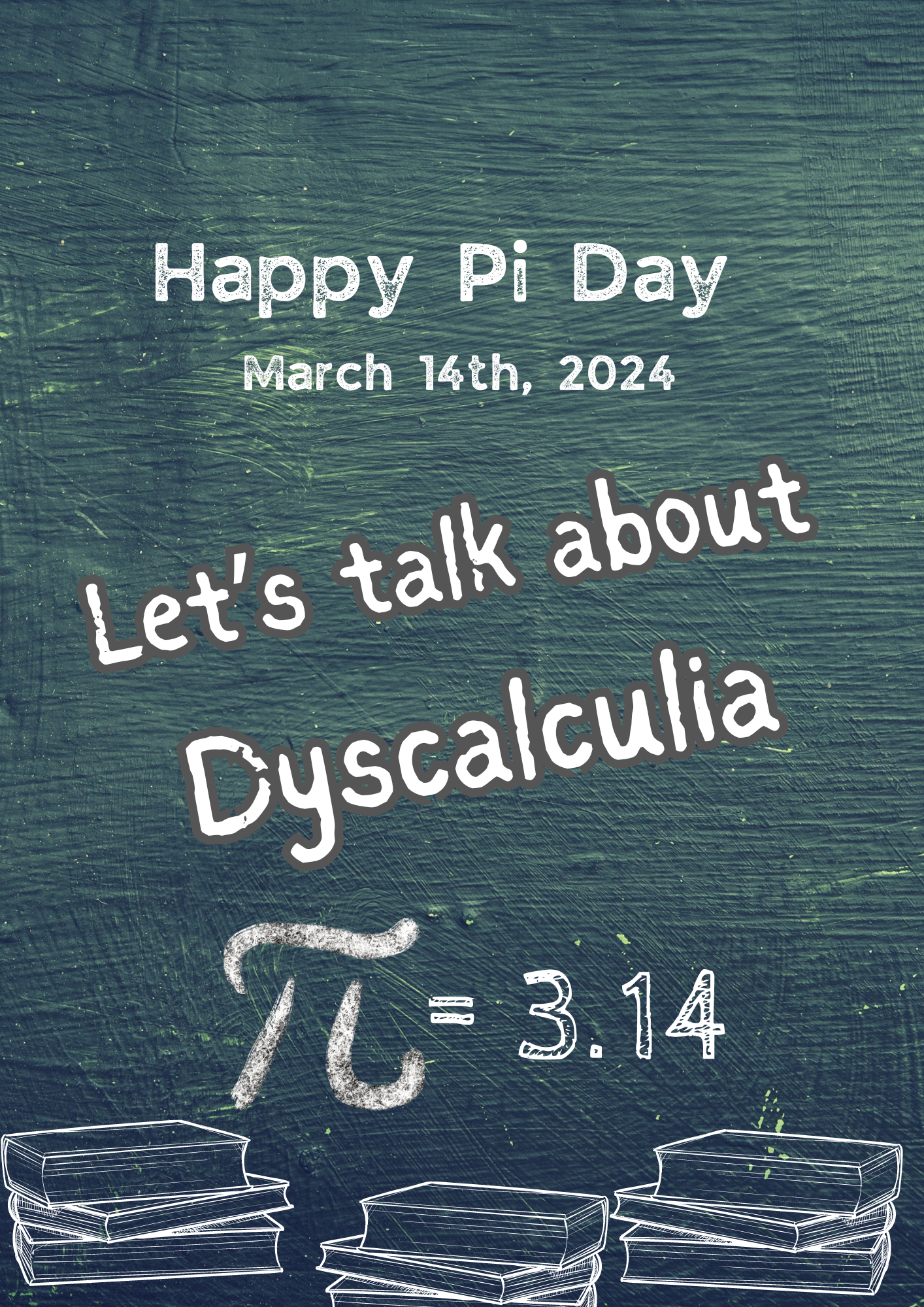
On International Pi Day, Cognitive Diagnostic Associates aims to increase awareness and understanding of Dyscalculia, a specific learning disorder that hinders an individual’s capacity to comprehend and manipulate numbers. Dyscalculia is marked by challenges in learning mathematical concepts and numerical reasoning, which can cause a substantial impact on academic performance and daily functioning across diverse settings. The prevalence of dyscalculia may vary, but estimates suggest that approximately 5-7% of the population may be affected by this learning disorder. Dyscalculia can impact individuals across various age groups and may persist into adulthood if not identified and addressed early. Furthermore, research indicates that dyscalculia affects both males and females at similar rates.
Individuals with dyscalculia may struggle with basic arithmetic, number sense, measurement, and mathematical problem-solving. In educational settings, it is important to recognize that dyscalculia can significantly impact academic performance. Studies have indicated that a notable percentage of students with dyscalculia struggle with mathematics-related subjects, leading to challenges in achieving academic success in these areas. Furthermore, the impact of dyscalculia extends beyond academic settings, affecting daily activities that involve numerical reasoning, such as time management, financial literacy, and spatial reasoning tasks.
Common Signs of Dyscalculia
- Difficulty understanding and recalling basic math facts and concepts, such as addition, subtraction, multiplication, and division.
- Struggling with number sense, including understanding numerical magnitude, relationships between numbers, and the concept of quantity.
- Challenges with mathematical problem-solving and reasoning, particularly when faced with complex or multi-step problems.
- Difficulty telling time, managing schedules, and understanding the concept of money, including making change and budgeting.
- Trouble understanding and working with measurements, such as length, weight, and volume.
- Difficulty with spatial reasoning tasks, including interpreting visual representations of mathematical concepts and understanding geometric shapes.
- Challenges with memorizing and recalling mathematical facts, formulas, and procedures.
- Lower academic performance in mathematics-related subjects despite effort and instruction.
Early Identification is Key!
If you notice these signs in your child, it’s important to seek a comprehensive evaluation by a qualified professional to determine if dyscalculia or other learning difficulties are present. Early support and intervention strategies for individuals with dyscalculia offer several benefits that can significantly impact their academic and personal development:
- Improved Academic Performance
- Enhanced Self-Esteem and Confidence
- Reduced Frustration and Anxiety
- Development of Coping Strategies and Appropriate Accommodations
- Great Long-Term Success
- Help Prevent a Decrease in Academic Motivation
At the conclusion of this insightful blog post, we extend our gratitude to Licensed Educational Psychologist, Jamie Carey, for her expertise and dedication in shedding light on Dyscalculia and its impact on International Pi Day. Jamie Carey authored this blog, drawing from her extensive knowledge and experience in the field.